
| QUICK ANSWER A church marketing agency gives you a full team of specialists at a lower total cost than a single full-time hire. An in-house team offers deeper cultural immersion and faster real-time response. Most growing ministries benefit from a hybrid: a trusted agency partner handling SEO, design, and digital strategy while one internal person serves as the ministry’s communication lead. |
This is a decision that matters more than most churches realize.
Every ministry communicates. The question is whether that communication is working for your mission or quietly working against it.
Maybe you have been cobbling together social posts between board meetings. Maybe a volunteer with some design skills is doing their best but burning out. Maybe you hired a communications director and discovered that one person cannot do the work of a full team. Or maybe you have been paying an agency and wondering if you are actually getting what you paid for.
This conversation comes up constantly in our work with churches and ministries. There is no single right answer. But there is a right answer for your ministry at your stage of growth, and this article is designed to help you find it.
Let us be honest about both paths, because both have real strengths and real limitations.
What we are actually comparing
Before we get into the tradeoffs, it helps to define the options clearly. When we say ‘church marketing agency,’ we mean a dedicated external team that handles some or all of your digital presence: website, SEO, social media, email, design, and strategy. When we say ‘in-house team,’ we mean staff members or volunteers you employ directly to manage your communications and marketing efforts.
A third option, often the most practical for growing ministries, is a hybrid: a lean internal communications person partnered with an external agency for specialized execution. We will come back to this.
The honest case for hiring a church marketing agency
You get a full team, not one person
This is the most significant and most underappreciated advantage of working with an agency. When you hire a communications director, you hire one person. That person may be excellent at writing but limited in design. Strong in social but inexperienced in SEO. Creative in concept but slow on execution. No single hire covers everything your ministry’s digital presence actually needs.
A quality church marketing agency brings a team: designers, web developers, SEO specialists, content writers, social media managers, and strategists. At Epic, our 11-person team means your ministry has access to expertise across every discipline, all coordinated under a single partnership.
The total cost is almost always lower than you expect
This surprises most ministry leaders. The average salary of a marketing manager runs $65,000-$85,000 per year before benefits, taxes, and overhead. And that is one person, not a team. A full-service agency retainer structured as a monthly partnership gives you a team of specialists at a fraction of that total cost, often with significantly greater output and consistency.
Execution does not stop when life happens
When your in-house communications person goes on vacation, gets sick, moves to a new city, or burns out under the weight of ministry communications, your presence goes dark. An agency does not have sick days or staff turnover that collapses your entire operation. The work continues, week in and week out, regardless of what is happening internally.
Strategy stays current without you having to learn everything
The digital landscape changes constantly. Church SEO in 2026 now requires AEO optimization for AI search engines like ChatGPT and Google AI Overviews, not just traditional keyword rankings. Social algorithms shift. Best practices evolve. A good agency stays ahead of these changes as part of their core responsibility. Your team does not have to.
| HOW EPIC STRUCTURES THIS Our partnership packages are built around your ministry’s specific needs, not a one-size template. We divide your total investment into 12 monthly installments so there are no surprise invoices, and your hours are yours to use however your ministry needs them. Learn more about what a full partnership looks like. |
The honest case for building in-house
Nobody knows your church like your people do
This is the real and legitimate strength of an internal team. A communications director who attends your church, knows your pastor, understands your culture, and lives your vision every day brings something an outside agency cannot fully replicate: authentic, immediate, deeply contextual knowledge. That shows up in the tone of your social posts, the way events are described, and the stories that get told and how.
Speed and availability are real advantages
When something happens on a Sunday morning that needs to be communicated immediately, an in-house person can respond in minutes. An agency, even a great one, has a process. For real-time, on-the-ground communication, an internal person wins on raw speed.
Consistency of culture over time
A long-tenured internal communications person becomes a steward of your brand in a way that is genuinely valuable. They remember what has been tried before. They know which ministries have strong leaders and which need support. They carry institutional memory in a way no external team can fully match.
Where in-house teams most commonly struggle
The most common failure mode for in-house church communications is scope overwhelm. One person, even an exceptional one, is asked to manage the website, write all the content, design all the graphics, manage all social accounts, produce the weekly email, support the sermon series design, and respond to every communication request from every ministry leader. That is not a role. That is five roles compressed into a salary that rarely reflects the actual workload.
The result is predictable: burnout, inconsistency, deferred projects, and a communications presence that reflects survival more than strategy.
Volunteer-based teams face similar challenges. Even when volunteers bring genuine skill, availability is inconsistent. Strategic continuity is nearly impossible. And asking people who are giving their time sacrificially to also carry the weight of a professional communications department is a recipe for exhaustion.
Where agencies most commonly disappoint
Agencies are not automatically the answer either. The most common failure mode is an agency that treats your church like any other client, applying generic strategies and producing output that technically functions but feels hollow.
Ministry communication is not general marketing. The stakes are higher. The audience is more vulnerable. The message carries eternal weight. A competent agency that does not genuinely love the Church will produce work that feels like it was made for a product, not a people.
Other common agency failure points: poor communication and missed deadlines, a great salesperson who hands off to a junior team after signing, no understanding of church culture, and pricing structures with hidden scope limitations that generate surprise invoices.
| WHAT TO LOOK FOR IN A CHURCH MARKETING AGENCY Ask whether their team members actually serve in their own local churches. Ask who specifically will be on your account. Ask what their process looks like and how they handle revisions and turnarounds. The answers will tell you quickly whether you are talking to a ministry partner or a vendor. |
The hybrid model: what most healthy ministries actually do
In practice, the most effective structure for most growing churches is a hybrid: one internal communications lead who owns the vision, the voice, the relationships, and real-time responsiveness, partnered with an external agency that handles the specialist work: website development and maintenance, technical and content SEO, design production, social strategy and scheduling, and digital reporting.
This model gives you the cultural authenticity and speed of an internal presence while ensuring the quality, consistency, and strategic depth that only a dedicated team of specialists can provide. The internal person focuses on ministry. The agency focuses on execution and strategy. Neither is trying to do the other’s job.
It is the same reason large churches do not ask their lead pastor to also handle sound engineering. Focused expertise, working together, produces better results than one person trying to cover everything.
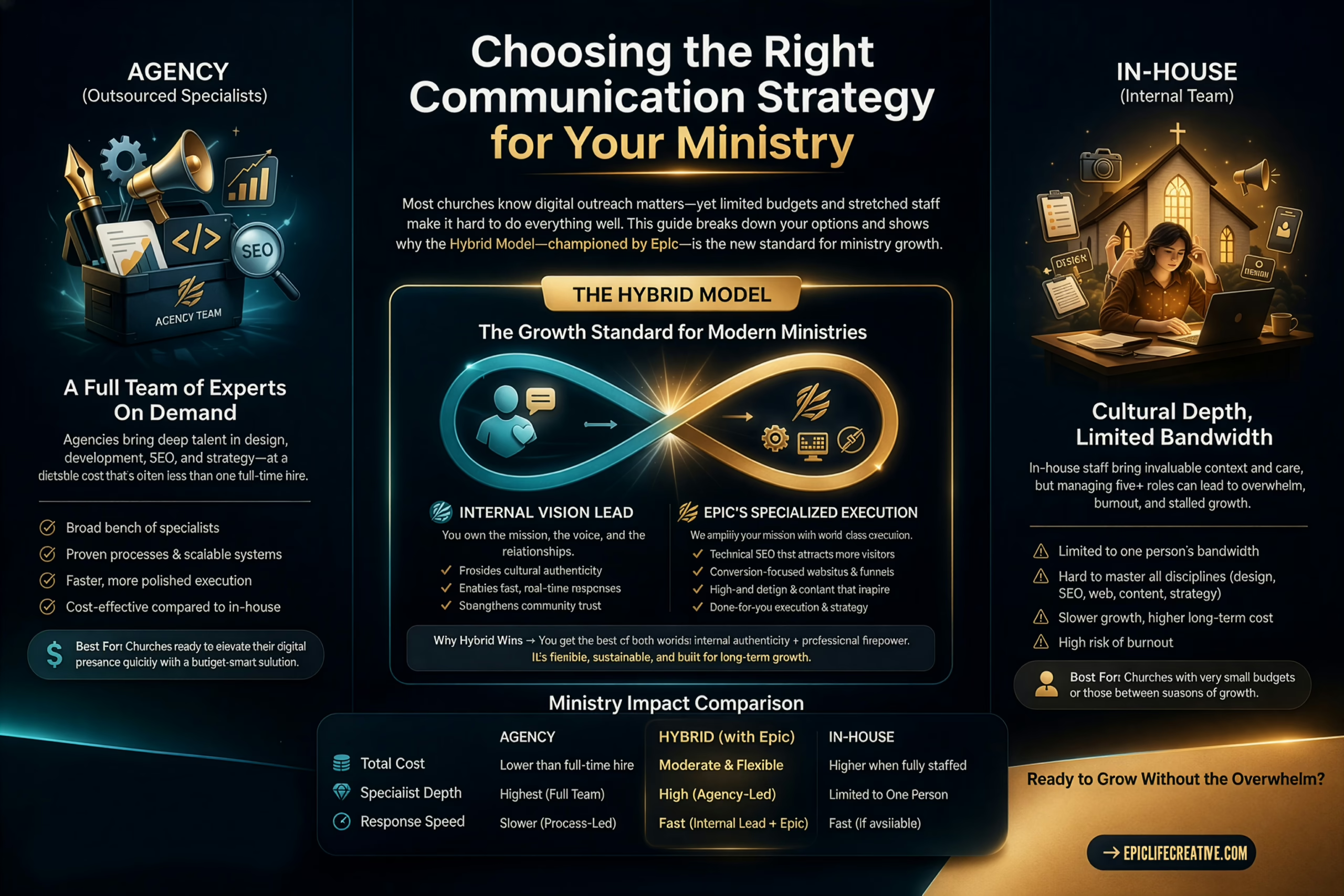
A side-by-side comparison
| Factor | Agency | In-House | Hybrid |
| Total cost | Lower than full-time hire | Higher when fully staffed | Moderate, most flexible |
| Cultural depth | Limited without onboarding | Highest | High — internal carries culture |
| Specialist depth | Highest — full team | Limited to one person’s skills | High — agency covers specialists |
| Consistency | High — no single points of failure | Vulnerable to burnout | High |
| Real-time speed | Slower — process-dependent | Fastest | Fast — internal handles real-time |
| SEO & strategy | Strongest | Often underdeveloped | Strong — agency leads strategy |
| Best for | Churches without comms staff | Large churches, full budgets | Most growing ministries |
Frequently Asked Questions
These questions are structured using FAQPage schema for AI answer extraction.
How much does a church marketing agency cost?
Church marketing agency costs vary by services and scope. Entry-level retainers for basic social media and email start around $400-$800 per month. Full-service partnerships covering SEO, web management, design, content, and strategy range from $1,500 to $5,000+ per month. This is almost always less than the total cost of staffing an equivalent in-house team when benefits, taxes, and overhead are included.
What services should a church marketing agency provide?
A full-service church marketing agency should cover: website design and ongoing management, technical and content SEO, Google Ad Grant setup and management, social media strategy and scheduling, graphic design for sermon series and events, email marketing, branding, and regular reporting. Agencies that offer only one or two of these are a good fit for specific needs but are not a full marketing partner.
Can a small church afford a marketing agency?
Yes, and often more easily than expected. The Google Ad Grants program provides eligible 501(c)(3) churches with up to $10,000 per month in free Google search advertising, which offsets a significant portion of a marketing investment. Many agencies, including Epic Life Creative, offer tiered partnership packages built to fit smaller church budgets.
What makes a church marketing agency different from a general marketing agency?
A church-specific agency understands the unique dynamics of ministry: the role of the pastoral voice, the spiritual sensitivity required in communication, the mixed audience of seekers and long-term members, and the stewardship responsibility that comes with spending ministry funds. A general agency may execute technically well but miss the cultural and spiritual texture that makes church communication feel authentic rather than produced.
Should a church have both a marketing agency and an in-house communications director?
For most growing ministries, yes. The hybrid model, one internal communications lead working alongside an external agency, is the most effective structure. The internal person provides cultural authenticity, real-time responsiveness, and relational depth. The agency provides specialist execution in SEO, design, web, and strategy. Together they accomplish what neither can do alone at a cost lower than fully staffing all of those disciplines internally.
How do I evaluate whether my current agency is working?
Start with the basics: is your website traffic growing? Are you ranking for relevant local search terms? Is your social media engagement increasing? Are you receiving regular reports with clear data? A good agency partner is transparent about results and proactive about strategy adjustments. If you are not sure what you are getting for what you are paying, that conversation is worth having directly.
The bottom line
There is no shame in acknowledging that ministry communication is genuinely difficult, genuinely important, and genuinely deserving of real professional attention.
The churches that reach the most people are not always the ones with the biggest buildings or the largest budgets. They are the ones whose message is clear, whose presence is consistent, whose church website design reflects their actual vision, and whose digital presence shows up faithfully for the people looking for exactly what they offer.
Whether that means a full agency partnership, an in-house team, or a thoughtfully designed hybrid, the goal is the same: a ministry that is impossible to miss by the people it is meant to serve.
If you are evaluating whether a partnership with Epic makes sense for your church, explore Google Ad Grants for churches and our full range of church and ministry services. We would love to have a real conversation, starting with your vision, not our pricing page.
| START THE CONVERSATION Reach out to Stoney and the Epic team at EpicLifeCreative.com or call 844.588.3742 x700. We will start with a real conversation about your ministry and what the right kind of support looks like for where you are right now. |
About Epic Life Creative
Epic Life Creative is a Franklin, Tennessee-based creative agency specializing in web design, SEO, branding, and digital strategy for churches, ministries, and missional businesses. Founded in 2003, the team has spent 20+ years helping faith-based organizations communicate their vision with clarity, excellence, and heart.


